
Showing posts with label AAMC. Show all posts
Showing posts with label AAMC. Show all posts
Monday, July 4, 2016
Friday, September 18, 2015
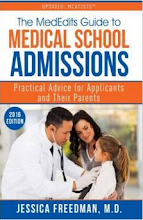
MEET DR. FREEDMAN! MEDEDITS BOOK SIGNING!new

Meet Dr. Freedman
Saturday, September 26, 2015
5:00 PM EDT
Are you an outstanding candidate hoping to attend a top-notch med school? A borderline applicant just hoping to get in somewhere? Meet Dr. Freedman and pick up a copy of her no-nonsense guide that will help you achieve your goals!


Tuesday, October 15, 2013
WE’RE JUST NOT THAT INTO YOU: WHY MEDICAL SCHOOL APPLICANTS GET REJECTED

Published in the January/February edition of PreMedLife
Every year medical school applicants feel confused and in the dark about why they have been rejected by medical schools. They do not understand what they did wrong or what they need to do differently when they reapply. Whether you are a premedical student trying to make sure to “do everything right” or a medical school applicant who has not yet been accepted to medical school, it may help to learn what applicants who are not accepted to medical school often have in common. Many of these problems are easy to avoid while others take a little more time and effort to remedy. Here are six problems I have observed:
1) Applying to a narrow range of medical schools. Everyone has told you that you are a great applicant and you should have no concerns. Premed advisors, friends, and family may advise you to reach high and that you don’t need to apply to more than 10 to 15 medical schools. I advise most students to be wary of this advice. While I always encourage medical school applicants to “aim high” and to have dream schools in mind, being realistic is also important. The competition for medical school admissions is fierce; fewer than half of 42,742 applicants matriculated in 2010/2011. So unless you have outstanding grades,MCAT® scores, letters of reference, experiences, written application materials, and a great interview experience, it is extremely important to cast a wide net and to apply broadly to a large range of medical schools. Sometimes applicants (or their advisors) overestimate their competitiveness and apply to mostly top-tier medical schools. These applicants are then surprised when they are not accepted to any of them. The bottom line is that, even if you are a top-notch applicant, you must consider adding to your list medical schools that are not ultra-selective.
2) Lacking clinical experience. You are applying to medical school, right? Then you must be able to demonstrate to the admissions committee that your experience fits this career decision. Many medical school applicants are interested in science and, while research is important, it cannot substitute for clinical exposure. Some medical school applicants submit applications with an impressive list of accomplishments and experiences but don’t demonstrate any clinical exposure, which comes in many forms: You can shadow your own family physician, volunteer in a free clinic or a hospital, or participate in a formal premedical program that includes time spent with physicians. It is very tough to convince an admissions committee via your written documents or during interviews that you want to pursue a career in medicine if you have never spent time in a clinical arena.

3) Submitting poorly composed written documents. Regardless of your candidacy’s strengths, composing persuasive application materials is essential for success. Whether you are competitive applicant seeking acceptance to the most prestigious medical schools in the country or a “borderline” applicant with lower than average grades, experiences, or MCAT® scores, your experience descriptions and personal statement must convince the people reviewing your application that you are worthy of an interview and an acceptance. This is especially important during the first stage of the medical school admissions process when the admissions committee decides whether or not to extend an interview invitation. The committee bases this decision on the objective material you present such as your academic profile, but your written materials, including your application and letters of reference, make a difference. You don’t have control over the content of your LORs, but you do have complete control of what you write in your application materials. Written documents that clearly and articulately express the evolution of your interest in medicine with introspection and thought are more likely to motivate the admissions committee to click the “interview” box when deciding your fate.
4) Having a lackluster academic profile. You have done “okay” in college and on your MCAT®, but is your performance strong enough to gain admission to medical school? Many medical school admissions committees “screen” applications; if your grades or MCAT® don’t reach a certain threshold, you are automatically rejected and your application isn’t reviewed. Other medical schools use a school-specific “formula” that takes into account your grades and MCAT® score and determines whether or not your application will be reviewed if you earn a minimum score. The general rule of thumb is that you must have an overall undergraduate grade point average (UGPA) of 3.5 with a strong performance in the sciences and a minimum MCAT® score of 30 to gain admission to medical school, but this rule has variations. For example, if your UGPA is lower than a 3.5, your MCAT® is a 31 and you have outstanding LORs, documents, and interview skills (see below) you can still gain admission to medical school. Medical schools also consider the rigor of your academic course load, undergraduate institution competitiveness, outside pressures (such as financial difficulties), and upward grade trend when evaluating how you performed. Many students perform poorly as a freshman in college and as they adjust to college life their grades steadily increase as they improve their study and time management skills; admissions committees consider this.
The evaluation of applicants is also subject to various nuances. For example, the student who attends a competitive undergraduate institution and pursued a difficult major, with a UGPA of 3.4 and an MCAT® 36 might be viewed more favorably than the student who attended a less competitive college, pursued a less rigorous major and had a 4.0 but earned a 31 on the MCAT®. In other words, to some extent admissions committees consider the competitiveness of your undergraduate institution and course load. At the same time, you need to realize that applicants’ MCAT® performances are the only measures admissions committees have for comparing “apples to apples.” This is why an exceptional MCAT® performance is important regardless of where you attend college.
5) Submitting a late application. You are an outstanding applicant but submitted a late application. Though this problem is easy to “fix,” you should understand why it’s important to rectify it. Every year the American Medical College Application Service® (AMCAS®) starts accepting medical school applications on or around June 1st And submitting your primary application as close to this opening date as possible is essential. Why? AMCAS® must review and verify your application, which can take up to six weeks (or more if there is a problem), and medical schools will review your application only after you are “verified” and they have received all supplemental application materials, such as letters of reference, Medical College Admissions Test (MCAT®) scores, and secondary applications and essays.
By submitting an early application you will be considered within a smaller pool of applicants early in the season. In contrast, applicants who wait until deadlines to submit their application materials are typically considered within a much larger pool of applicants. In addition, because early applicants have been invited for some of a school’s finite number of interviews, those who apply late are competing with a large number of applicants for fewer interview slots. Similarly, for medical schools with rolling admissions, interviewing late in the admissions season is less than ideal since in March or April, for example, most initial acceptance offers have been extended. This means that even if you are a competitive applicant, the medical school may not have any more interviews or acceptances to extend. This is why many great applicants who submit late applications, receive “hold”, ‘reject,” or “wait list” decisions rather than acceptances.
If you are rejected by medical school and decide that your academic record needs to be enhanced, you have many options. If grades are the issue, consider taking upper division classes at a four year university after graduation. Postgraduate special master’s programs specifically designed for students who want to attend medical school are also a good alternative; a searchable database of such programs is available from the Association of American Medical Colleges: http://services.aamc.org/postbac. Other possibilities are to pursue a master’s in public or global health or in a specific scientific discipline in which you are interested. These are all great options if you need to improve your academic profile. If your MCAT® is the concern, you must critically evaluate what you need to do to improve so you can target your studying.
6) Demonstrating poor interview skills. Once an applicant reaches the interview stage, the interview is the most important determinant of success. Typically, interviewees with great interpersonal skills and emotional intelligence are naturally better interviewees than applicants who are more introverted. Applicants who are very nervous, not articulate, or who aren’t comfortable peaking about themselves can under-perform during the interview. Even though some US medical schools are adopting the multiple mini interview (MMI) format, most medical schools still conduct one-on-one interviews. Contrary to what most medical school applicants believe when they start this process, medical school interviews are typically relaxed dialogues; the interviewer is trying to get to know each applicant, assess if he or she has the qualities and characteristics the school is seeking in medical students, and if he is a good fit for the school. While a certain degree of subjectivity influences every interview experience, applicants can perform well if they practice speaking about themselves before the interview and if they clearly express their motivations and experiences that influenced their decision to practice medicine.
I have seen applicants fail to be accepted to medical school again and again for one or more of these “Top Six” reasons. Nonetheless, how a school weighs each of these factors, among others, is determined by each applicant’s unique profile and situation and the criteria and admissions process of that particular school. Always remember that each medical school considers every candidate individually and there are many things you can do to improve your chance of success.
Reference: Association of American Medical Colleges Facts: https://www.aamc.org/data/facts/
Photo courtesy of Sean MacEntee Flickr
JESSICA FREEDMAN, M.D., is president of MedEdits Medical Admissions (www.MedEdits.com) and author of the MedEdits Guide to Medical Admissions and The Medical School Interview. Follow Dr. Freedman and MedEdits on Facebook and Twitter.
This article appeared in the January/February 2012 issue of PreMedLife magazine.
This article appeared in the January/February 2012 issue of PreMedLife magazine.
Tuesday, March 15, 2011
AAMC and ERAS Websites Down
Due to the high volume of traffic during match week, the AAMC and ERAS websites are currently down.
Friday, August 7, 2009
ERAS Worksheet and Resources
As residency applicants get ready to submit their residency applications, they should review the materials offered by the Association of American Medical Colleges (AAMC) that may help. Most important is the ERAS worksheet which outlines what is required for the ERAS application, character limits, experience categories etc.
Find your ERAS resources to download here.
Visit: MedEdits
Find your ERAS resources to download here.
Visit: MedEdits
Friday, June 5, 2009
Medical School Admission Requirements: Is Change On The Horizon?
A report released by the Association of American Medical Colleges and The Howard Hughes Medical Institute recommends significant change in the premedical curriculum. Rather than requiring students to take specific courses, the report suggests that students be proficient in a specific set of competencies. While these changes will not happen for a while, the MCAT will also also have to be modified. The AAMC has formed an MCAT review committee and that reevaluation is underway. This MCAT review will be complete in 2012 and the goal is to recommend changes that will make the exam more useful for medical school admissions.
Friday, May 1, 2009
Post Baccalaureate Premedical Programs and Special Master's Programs
I was speaking with a client today who is considering attending a special master's program to enhance his academic record and help his chances of gaining admission to medical school. He asked where he could find a comprehensive list of these programs. The AAMC provides a searchable database of programs based on program type and characteristics (post bac, career changer, academic enhancement and length etc.)
Click Here for the AAMC link.
I help clients with written application documents when applying to these programs. I also advise clients regarding their options and how these programs might increase their chances of being admitted to medical school.
Visit: www.MedEdits.com
Read our testimonials.
Check out our clients' success.
Wednesday, April 15, 2009
Open Residency Positions: Find A Resident
I have received several queries from prospective clients about finding available positions for residency. The only service I recommend to clients is Find A Resident, a service sponsored by the Association of American Medical Colleges. Click Here to access the site.
I am actively working with residency clients for the 2009/2010 application season. If you are interested in working with me, I encourage you to retain my services early.
I am actively working with residency clients for the 2009/2010 application season. If you are interested in working with me, I encourage you to retain my services early.
Thursday, April 2, 2009
No Medical School Acceptances or No Residency Match?
If you are applying to medical school this year and have not yet received any interviews, it is unlikely that you will. You must consider now if you will reapply in the upcoming season and what you will do to enhance your candidacy.
If you did not obtain a residency match this year, you must also consider reapplying for the match in September. Some prospective clients who did not match this year have emailed me to inquire about available positions for July 2009. The only service I recommend using is FindAResident which is sponsored by the AAMC. Many for profit "post-scramble" companies are a scam and I do not advocate using them.
I am already working with medical school and residency clients for the upcoming application season. Based on my clients' success in 2009, I anticipate that I will become booked and encourage all interested applicants to retain my services early. As a commitment to my clients, I limit the number of applicants with whom I work.
Sunday, March 15, 2009
AAMC Online Admissions Resource
The Association of American Medical Colleges (AAMC) has taken on many initiatives to improve the medical school selection and admissions process to create a more diverse and caring population of physicians in the future. These admissions initiatives are summarized by the AAMC and are divided into three categories: Diversity, Medical School and Physician Workforce Expansion and Student Selection.
Click Here to access this new online resource provided by the AAMC.
Visit: www.MedEdits.com
Click Here to access this new online resource provided by the AAMC.
Visit: www.MedEdits.com
Sunday, March 8, 2009
Official Guide to the MCAT from the AAMC

The Association of American Medical Colleges has just published a guidebook to help prepare applicants for the MCAT. This guide contains actual MCAT exam questions and passages, exam taking tips and data to help you decide if retaking the exam will improve your score.
Click Here to purchase from the AAMC site.
Visit: www.MedEdits.com. Visit us at the American Medical Student Association annual convention this week!
Monday, February 16, 2009
Residency Match: Important Dates and The Scramble
As the 2008/2009 residency application season comes to a close, I thought it was a good time to review some important dates. Most programs have finished interviewing applicants, have had their annual "rank meeting" and are in the process of entering their rank order list (ROL). Applicants should also be submitting their ROL now.
Some dates:
February 25th: ROL certification deadline.
March 16th: Applicant matched and unmatched data posted at 12 noon EST.
March 17th (Scramble Day!): Filled and unfilled results for individual programs posted at 11:30 AM EST.
March 17th (Scramble Day!): Locations of unfilled positions released at 12 noon EST. Individuals may start contacting programs at this time.
March 19th: MATCH DAY! Match results posted at 1 PM EST.
As announced at the AAMC meeting this fall, the NRMP and the AAMC are jointly establishing a scramble work group to address issues related to the scramble and to propose changes for reform.
In 2008, roughly 13,000 applicants competed for 1,300 unfilled positions during the scramble. More than half of these unfilled positions were filled by 4 PM on scramble day. Many applicants (mostly IMGs) do not submit a ROL and register for the match just to receive the list of unfilled spots. Thus, the chances of obtaining a spot via the scramble is slim. For-profit companies who claim to "fax" materials to programs on behalf of clients also jam fax machines and lines of communication making the process challenging for unfilled programs.
While I will be available for my existing clients during the scramble (although I don't anticipate they will need any help!), I will not be offering any services for new clients during the scramble. We wish all of our residency clients good luck in the match this year and look forward to hearing about your success. If you are interested in hiring us to help you through the application process for the 2009/2010 season, we encourage you to retain our services early.
Visit: www.MedEdits.com
Saturday, February 14, 2009
Medical Education: A Report By The Macy Foundation
A report issued by the Josiah Macy Jr. Foundation, a philanthropic organization dedicated to improving medical education and enhancing minority representation in the health professions, suggested reforms to improve medical education at time when medical school are increasing enrollments.
This is an interesting report and addresses three main concerns:
1) The growing amount of debt that medical students incur.
2) Medical student bodies do not represent the racial, economic and geographical makeup of society at large. Schools were encouraged to reexamine admissions policies and the reliance placed on MCAT scores.
3) Students are encouraged to maintain professionalism but, often, these standards are not exhibited by respected role models in the health care setting.
This is an important report to read for anyone involved (or soon to be involved!) in medical education. Click Here to read the report. Click Here to read the AAMCs response the report.
Tuesday, October 21, 2008
Good News For Medical School Applicants: Slightly Less Competition
A report released by the Association of American Medical Colleges today showed a slight decrease in the number of applicants in 2008 and an increase in the number of first year positions. The number of first time applicants decreased 3% from 2007. First year enrollment increased 2% since 2007 to more than 18,000 students, an all time high in our nation's history.
The number of Latino enrollees rose by 10% and the percentage of women enrollees was 48%.
The average GPA for applicants was 3.5 and the average MCAT was 28.1.
Click Here to read the report.
The number of Latino enrollees rose by 10% and the percentage of women enrollees was 48%.
The average GPA for applicants was 3.5 and the average MCAT was 28.1.
Click Here to read the report.
Click Here to see the data.
Visit: www.MedEdits.com.
Thursday, October 16, 2008
Medical School Applications And The Economy: Lessons From The Past
Some medical school clients who are applying for 2010 and 2011 have asked me if the current economic crisis will result in an increase of medical school applications (and increased competition). While I am not an economist, looking at previous trends helps predict the impact of our current economic situation.
As discussed in a New York Times (NYT) article written during the most recent recession in 2002, the only professional schools that are unaffected by recessions are medical schools. This is because a career in medicine requires a significant time commitment compared to other professions.
The AAMC reporter in 2003 indicated a 3.4% increase in applications (34,785 applicants) for the 2003/2004 academic year which was in part attributed to the economic slowdown at that time. There has been a steady increase in the number of medical school applications since 2002/2003 and 42,315 individuals applied for the 2007/2008 academic year.
Click Here to read the NYT article.
Click Here to read the AAMC article.
This is an issue that is being widely discussed right now amongst students and admissions committee members. I welcome your comments and thoughts on this topic.
Visit: www.MedEdits.com.
Email me: info@mededits.com
Wednesday, September 10, 2008
Medical School Admissions: Holistic Review
I encourage everyone who is applying to medical school now or in the near future to read a publication by the Association of American Medical Colleges (AAMC) called The Roadmap To Diversity: Key Legal and Educational Policy Foundations for Medical Schools. This report outlines the mission of the AAMC Holistic Review Project. Not only is this important to read from an admissions standpoint but you will also sound smart on the interview trail if the topic comes up!
Click Here to access the report.
Visit: www.MedEdits.com
Click Here to access the report.
Visit: www.MedEdits.com
Thursday, August 14, 2008
Admissions: Battles Over Affirmative Action
An article in the AAMC reporter discusses the issue of affirmative action in Arizona, Colorado and Nebraska. Votes in these states could impact the right for public institutions, including medical schools, to have race and gender based hiring and admissions policies. This is a hot debate with some saying it is time for a race-neutral society and others advocating that such policies are crucial for diverse academic and professional environments.
"I don't think affirmative action is the cure-all," Boyd (of Rush Medical College and AAMCs Minority Affairs Coordinating Committee) said. "Admissions committees should start to look at the individuals, and the roads they've traveled to get to medical school."
Click Here to read the article.
visit: www.MedEdits.com
Monday, August 4, 2008
Residency Match Data
The residency application season is approaching and many candidates are considering where to apply. When making this decision, it is important to review the data that is available from previous NRMP matches.
Charting Outcomes in the Match, published by the AAMC and NRMP, provides easy to read graphs showing the distribution of successful and unsuccessful applicants based on USMLE scores, number of programs ranked, research and publications, AOA membership and other characteristics. Even though this information is from the 2007 match, it is a useful reference. Click Here to access the report.
The most recent data from the NRMP provides information on the 2008 match. Click Here to access the report.
Visit: www.MedEdits.com
Wednesday, July 2, 2008
Assessing Medical School Admissions Policies
The Association of American Medical Colleges has released a compelling report that assesses medical school admissions policies based on two Supreme Court affirmative action decisions. This report outlines suggestions for race and ethnicity conscious policies for medical school admissions committees. What is the implication of this for applicants? Applicants will be evaluated in an "individualized" and "holistic" fashion so that race and ethnicity are only one of many factors that are taken into account. Admissions committees may also be restructured based on these considerations. Click Here to read the report.
Visit us: http://www.mededits.com
Visit us: http://www.mededits.com
Subscribe to:
Posts (Atom)




 Posts

