
Showing posts with label get into medical school. Show all posts
Showing posts with label get into medical school. Show all posts
Sunday, August 21, 2016
Don't miss our next FREE informative medical school, residency, and fellowships admissions seminar in NYC on September 24th.
Click here to register: http://meetme.so/MedEditsSpringSeminar
Click here to learn more: http://goo.gl/I83gOk
Location: Midtown Manhattan. Directions will be sent with the confirmation email when you register.
Not in New York? View our seminars live on our Facebook page by registering: https://goo.gl/AXZGMX We'll send you updates and reminders.


Saturday, July 23, 2016
Dr. Freedman answers your medical school and residency questions.
MedEdits Medical School, Residency, and Fellowship Summer Admissions Seminar. New York City medical school and residency seminar 8/16/16
Sunday, July 10, 2016
MedEdits' Medical School Secondary Essay Essentials Webinar 2016 - 2017
Dr. Jessica Freedman held a free medical school secondary essay webinar with Q&A for current MedEdits clients, prospective clients, and their families.
Watch the recording above.
Do you have questions or concerns about your medical school secondary essays?
Can't find the answers?
Want to stand out from the crowd?
Click here to learn about MedEdits' Secondary Essay Services: http://goo.gl/7SOtgM
-----------------------------------------------------------------
Popular Secondary Essay Articles by Dr. Freedman
How Do I Approach Secondary Essays? http://goo.gl/H4mVmM
Medical School Secondary Essays 2016/2017 http://goo.gl/IMJOIW
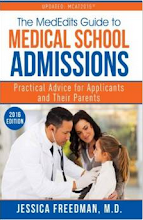
Also, read more about secondary essays in Dr. Freedman's book: https://goo.gl/RB5g48, The MedEdits Guide to Medical School Admissions: Practical Advice for Applicants and their Parents
Available in Paperback or Ebook.
Friday, July 8, 2016
Friday, September 18, 2015
MEET DR. FREEDMAN! MEDEDITS BOOK SIGNING!new

Meet Dr. Freedman
Saturday, September 26, 2015
5:00 PM EDT
Are you an outstanding candidate hoping to attend a top-notch med school? A borderline applicant just hoping to get in somewhere? Meet Dr. Freedman and pick up a copy of her no-nonsense guide that will help you achieve your goals!
Sunday, May 18, 2014
Sunday, March 23, 2014
Medical School Personal Statement: A Few Guidelines To Follow

1) Be true to yourself. Everyone will have an opinion regarding what you should and should not write. Follow your own instincts. Your personal statement should be a reflection of you, and only you.
2) Start your personal statement with something catchy. Whether you choose to write about a pivotal experience in your life that inspired your interest in medicine, or a personal experience that is very meaningful, be sure to capture your reader’s interest at the outset.
3) Don’t rush your work. AMCAS, TMDSAS, and AACOMAS have “opened.” Don’t panic. It is still very early. Composing great documents takes time and you don’t want your writing and ideas to be sloppy and underdeveloped. Your application materials must be authentic, but sometimes a little inspiration helps.
Read The MedEdits Guide to Medical School Admissions. There you will find examples of ‘successful' personal statements and application entries.

visit www.mededits.com to schedule your FREE 15 minute consultation.
 |
 |
 |
|
||



For Email Marketing you can trust
Monday, January 27, 2014
Monday, January 13, 2014
MEDEDITS: THE MEDICAL SCHOOL PERSONAL STATEMENT

How should you start your medical school personal statement? You hear conflicting advice. Some tell you not to open with a story. Others tell you to always begin with a story. Regardless of the advice you receive, be sure to do three things:
1) Be true to yourself. Everyone will have an opinion regarding what you should and should not write. Follow your own instincts. Your personal statement should be a reflection of you, and only you.
2) Start your personal statement with something catchy. Whether you choose to write about a pivotal experience in your life that inspired your interest in medicine, or a personal experience that is very meaningful, be sure to capture your reader’s interest at the outset.
3) Start writing now! Composing a great medical school personal statement takes time.
4) Make sure your personal statement is about you! Your medical school personal statement is not the place to write about your views or about other people.
Your application materials must be authentic, but sometimes a little inspiration helps. Read The MedEdits Guide to Medical School Admissions. There you will find examples of ‘successful’ personal statements and application entries.

Friday, January 10, 2014
Interview Strategies and More
The Latest MedEdits Medical Admissions News.
http://myemail.constantcontact.com/INTERVIEW-SEASON-STRATEGIES-AND-MORE.html?soid=1102913833847&aid=2uiac2yFB24

Wednesday, January 8, 2014
An Applicant's Interview Attire Tips

1) Interviews are like first dates. Do people ever go on first dates without any foundation? Always wear foundation.
2) Don't wear chunky, or multiple chunky rings.
3) Velvet jacket. Seriously?
4) Baggy suits. Bagginess went out of style in 1999. Nobody wears a 5 button suit anymore. Consult GQ style guide 2013 for pointers.
5) Texting while walking during interviews. Lame.
Many interviewers are not style mavens so most won't notice if you are wearing something that dates back to the 90s, however, it is important to look and act like a professional; be sure to turn off the mobile device, take off the black nail polish, and any over-the-top fashion accessories.
What tips do you have?
Tuesday, January 7, 2014
MEDICAL SCHOOL ADMISSIONS & SOCIAL MEDIA
 Your online image will follow you forever. Whatever is “googleable” about you now can always be found. The findings of a recent study by The University of Miami in the Postgraduate Medical Journal about social networking and medical admissions indicate that information on social networks could impact your success during any medical admissions process. About 9% of admissions officers surveyed in this study say they routinely review social networking sites when evaluating applicants. Reputation management should start early; be careful about what you post and with whom you associate. “What people put online is really a part of their history. … You have to be extremely careful about what you put out there,” said Dr. Carl Schulman, the study’s lead author. While this study did not focus on internet content in general, it might be fair to assume that some admissions officers also “google” applicants and do not focus solely on social networking sites.
The question really becomes: How can you use social media and the internet so it helps you? Put out great content about yourself on the internet. Consider writing a blog about your interests or curiosities. Start interesting dialogues. Say something smart! That way, if anyone chooses to “google” you at any point in your career, they will be pleasantly impressed.
 |
| Visit www.MedEdits.com to sign up for your FREE 15 minute session. |
Applying to Medical School in 2014?
 If you are applying to medical school in 2014, now is the time to start getting organized. The first step is to meet with your premedical advisor (if you have one).
Some undergraduate and postbaccalaureate premed advisors are excellent and experienced while others don’t really understand the medical school admissions process and are overwhelmed with the number of students they must help. Nonetheless, if you have a premed advisor who will be responsible for writing your committee letter or sending our your letter packet, you must keep her “in the loop” and involved in your application process, whatever her skill set and insight.
Premed advisors may also advocate for students both on the premedical committee and during the admissions process. Therefore, even if you don’t think highly of your premed advisor, you must still be respectful and considerate towards her and be sure she is aware of your plans. Meet with your premed advisor periodically during your undergraduate career because your success will be partly dependent on her efforts.
This is an excerpt from The MedEdits Guide to Medical School Admissions.

Monday, January 6, 2014
Medical School in Three Years
Many major news organizations, including The New York Times, have been writing about three year medical school programs at institutions such as New York University, Texas Tech and Mercer. Such programs are ideally suited for very focused and directed students - those who have a crystal clear idea of what specialty they would like to pursue before starting medical school.
In many ways, such programs are similar to accelerated medical programs that allow students to get both their undergraduate and medical degrees in a shorter time than they would by pursuing the two degrees separately. But three year medical school programs have a downside. Students who take accelerated paths to residency must be exceptionally mature and clear about what they want. For many medical students, medical school offers time to explore career options; for these individuals, being forced to choose a specialty in the second year of medical school wouldbe detrimental since they would have less time to consider deeply the specialty that might be the best fit for them.
While a three year pathway would save students time and money and “speed up” the transit of physicians through the pipeline, it might also produce physicians who are not happy with their career choices.
See my earlier article that relates to this topic and was published on KevinMD, 4 Bad Reasons Why Students Choose a Specialty.
Caribbean Medical Schools

This article about Caribbean Medical Schools, which was originally published on The Student Doctor Network, continues to be a top-ranked post on the site.
Whenever I start working with a student who is applying to medical school “in the Caribbean,” I ask them to think about several factors. Some students who attend Caribbean medical schools earn excellent residency positions in the United States; however, prospective students should be aware that the path to becoming a physician as a Caribbean medical student poses unique challenges. In 2012, 49.1% of US Citizens educated at international medical schools earned a residency match. Thus, it is extremely important to attend a well-reputed Caribbean medical school with high match rates if you choose this route to medical practice. Graduating and earning a residency match as a Caribbean medical student requires extra focus, planning, and initiative.
It is essential to realize that all Caribbean medical schools are not created equal. While several well-known Caribbean medical schools have graduated many physicians who now practice, I am always amazed by the number of “new” schools that are established. All international medical graduates must receive accreditation from the Educational Commission for Foreign Medical Graduates (ECFMG®); however, currently the only requirements for ECFMG certification are passing the USMLE Step 1, Step 2 CK, Step 2 CS exams and having at least four credit years from a medical school listed in the International Medical Education Directory (IMED).
Don’t assume, if you are accepted to “a Caribbean medical school,” that this guarantees a residency match. Caribbean medical schools are for-profit entities and, based on my experience, some schools accept students whose backgrounds and academic records predict a likelihood of failing the USMLE Steps 1 and 2 (CK) which all students must pass before they start residency training. Caribbean medical schools will not reveal how many students enroll as first year students yet fail out and never “make it off the island” for third year rotations.
Gauging the quality of the medical education you will receive at a particular Caribbean medical school isn’t easy, but you can get an idea of how successful graduates are in obtaining residency training positions in the United States by considering several factors.
What are the school’s average USMLE Step 1 scores?
The results of the USMLE Step 1, which is taken after the preclinical years, become an extremely important factor for residency match success. Why? The USMLE Step 1 score is the only objective piece of data that program directors can use to compare medical students and residency applicants. The USMLE Step 1, which was initially designed as a qualitative test to evaluate competency, has evolved into a quantitative test, so the higher your score, the better. When I was a medical student, it was not the norm for US medical students to prepare for the USMLE by taking “prep courses.” I find that because of the technology now available, however, most students enroll in courses, often online, and are achieving high scores. A great USMLE Step 1 score will not, however, guarantee a match in the more competitive specialties. It is important to consider the other “ingredients” that lead to success.
Where do students complete third and fourth year clerkships?
It isn’t enough if a Caribbean medical school promises “rotations in US hospitals.” Prospective students should know where, specifically, students rotate, the number of students on each rotation, and the process for designing the clinical schedule. Completing a rotation in internal medicine at a hospital with an ACGME approved residency program, for example, would be considered more challenging and would most likely yield a better foundation of knowledge and skills in internal medicine than a program without this affiliation. “Academic rotations” are looked upon most favorably by residency admissions committees, and letters of reference from academic faculty also carry more weight than those from community physicians.
Some Caribbean students also complain to me that rotations are becoming too crowded; they feel they are competing for patients and procedures and are receiving little teaching. Thus, it is important to know how many students rotate at each clinical site and how many other schools also rotate through those sites since many hospitals have students rotating from several medical schools at one time.
A recent article in The New York Times outlines how New York State medical schools currently are addressing these issues by trying to limit the rotations that Caribbean medical students complete at New York hospitals. New York medical school officials are concerned that the large numbers of Caribbean students at these hospitals dilute US medical students’ education and cause rotations to be crowded. It is unclear how this “turf war” will play out; Caribbean medical schools pay hospitals large sums of money for their students to rotate. St. George’s Medical School, for example, recently signed a 10-year, $100 million contract with the New York City Health and Hospitals Corporation (HHC) and sends about 1,000 students to these hospitals each year. Under New York State’s proposal, Caribbean medical students would be permitted to do only fourth elective rotations at New York hospitals, which poses special challenges that the article did not address. (Read Dr. Freedman’s published letter to the editor in response to the New York Times article.)
Does the Caribbean school encourage away electives?
Doing “away electives” at hospitals where students hope to do residency is often a key to success. Students complete away electives not only as “audition electives” but also to receive letters of reference from faculty at these programs. All international students, whether they are US citizens or not, sometimes find it difficult to obtain away electives at their “ideal” hospitals; being aware of this fact is essential for planning.
US medical students use the Visiting Students Application Service (VSAS) to obtain many away electives. Because this service is run by the Association of American Medical Colleges, Caribbean students cannot use it and therefore must apply individually to each hospital at which they want to rotate. And even if their residents are international medical graduates, many hospitals have policies that prohibit them from allowing these students to rotate. Some hospitals, including some HHC hospitals that recently contracted with St. George’s, will allow St. George’s students to rotate but won’t allow other Caribbean medical students to do rotations. Individual departments within a hospital also may have specific policies regarding international rotators. For example, one department within a hospital might allow international students to rotate while another might not. Therefore, it may require a tremendous amount of persistence for Caribbean medical students to obtain away rotations, and students should start seeking out information regarding which hospitals accept international medical students as rotators when they choose their desired specialty.
Where do the Caribbean school’s students match?
The be all and end all indicator of success is a medical school’s match list, many of which are published on schools’ websites. But, interpret these lists carefully. First of all, you want to know what percentage of graduating fourth year students obtain categorical matches. Why is this significant? Preliminary positions are only one year and do not guarantee a specialty match or board eligibility. Categorical positions, on the other hand, are specialty matches and do guarantee board eligibility. Many published school lists do not distinguish between preliminary versus categorical matches. One major Caribbean medical school recently disclosed at a faculty meeting that 15% of its graduating students did not obtain categorical positions last year. This information, is not easy to obtain, however, and for obvious reasons schools rarely disclose this raw data to prospective students and their parents.
How do US citizen IMGs perform nationally?
It is also essential to review the national data to see how US citizen IMGs fare in the match. In the past, the National Residency Matching Program (NRMP) released data that divided applicants into only two categories: US seniors and independent applicants, which limited interpretation of this data (See Charting outcomes in the match). Recently, however, the NRMP has started to further categorize this data, clarifying how each group performs. There is now a category for “US Citizen IMGs” and, even though this includes all US citizen international graduates, a large number of this group are Caribbean students.
The number of active US citizen IMGs in the 2010 Match was 3,695, which is 1,260 more than five years ago; 1,749 were matched to PGY-1 positions, down 0.5 percentage points from last year. (Resource: http://www.nrmp.org/data/resultsanddata2010.pdf) This data may be misleading, however, since it is not clear how many of these 3,695 students received “prematch” offers and therefore did not go through the match. Only international medical students and international medical graduates can accept “prematch” offers; US medical students cannot receive prematch offers.
Reviewing this data further, most US citizen IMGs match in internal medicine and family medicine; it is extremely difficult to match in competitive specialties. In 2010, for example, only one US citizen IMG matched in plastic surgery, otolaryngology, and dermatology. (Resource: http://www.nrmp.org/data/resultsanddata2010.pdf)
Looking Ahead
The ECFMG announced that, effective in 2023, all applicants and physicians “will need to graduate from a medical school that has been appropriately accredited” to receive ECFMG certification. This means that the medical school will need to be accredited through the Liaison Committee on Medical Education or other organizations such as the World Federation for Medical Education (WFME). Physicians must be ECFMG certified to take the USMLE Step 3 and to obtain an unrestricted license to practice medicine in the United States. Therefore, holding Caribbean and all international medical schools to higher standards will force schools to create curriculums that lead to better medical educations and graduates’ success.


Sunday, January 5, 2014

MedEdits Review Internet

MEDEDITS REVIEW Internet
Below is only a sampling of the unsolicited praise we have received from MedEdits clients and parents.
“Thank you so much! I can never thank you enough for how much you helped me. You'll definitely hear from me again when it comes time to apply for residency!!”–Medical School Client-----
“Thank you so much for helping my son last year with his Six Year Med Program. He is very happy to get his first choice. He already finished his first year. My husband and I just like to say thank you so much for the work you are doing to help young people. God bless you and keep you HAPPY AND HEALTHY so you can keep working. THANKS AGAIN.”–Parent of BS/MD Client-----
“I just wanted to tell you that I GOT IN!! :) I was the first on the waitlist and have officially received my offer of admission. I just wanted to say again how grateful I am for your help. The whole team on MedEdits has been wonderful and I look forward to working with you again in the near future.”–Medical School Client-----
“I got into [medical school name deleted] off the waitlist! I am really excited- after the interview it became my first choice. I want to thank you for everything you have helped me with in this very long application process. After all of your essay edits I have learned how to present myself as a candidate, which is a great skill to have. You also gave me advice that I think directly led to my interview there, and have been incredibly helpful with waitlist strategy. Thank you for everything.”–Medical School Client
For more MedEdits reviews, click here.-----
For more MedEdits reviews, click here.-----
Wednesday, January 1, 2014
Letter of Intent: What should be included?
Letter of Intent: What should be included?
1) Introduce yourself. Include the date of your interview and the status of your application. State why you are writing the letter -- to provide an update of your accomplishments and/or to express your interest in the school. If you can honestly state that the school to which you are writing is your #1 choice and you will attend if accepted, that, too, should be stated in the first paragraph.
2) Provide an update of any recent accomplishments; include information on academic achievement, extracurricular involvement, clinical exposure, research, etc. List all course work and grades earned. Most schools will not require official transcripts.
3) Express, SPECIFICALLY, why you are interested in the medical school. Try to go beyond the "basics" such as mentioning the curriculum or the student-run free clinic, for example. Try to relate your interest in the school to something in your background. Does the school have an excellent neurology department and do you have a demonstrated interest in this specialty, for example. In other words, don't write what every other applicant might write. Your interest in the school should reflect who you are and what you have done.
Letters of intent DO influence admissions committees decisions. Schools want to accept people who are enthusiastic about attending and they also want to accept people whom they know will attend, especially when it is crunch time and close to the start of classes.
Questions or comments?
Visit: MedEdits to sign up for a FREE 15 Minute Consultation.
Letter of Intent: What should be included?
Letter of Intent: What should be included?
1) Introduce yourself. Include the date of your interview and the status of your application. State why you are writing the letter -- to provide an update of your accomplishments and/or to express your interest in the school. If you can honestly state that the school to which you are writing is your #1 choice and you will attend if accepted, that, too, should be stated in the first paragraph.
2) Provide an update of any recent accomplishments; include information on academic achievement, extracurricular involvement, clinical exposure, research, etc. List all course work and grades earned. Most schools will not require official transcripts.
3) Express, SPECIFICALLY, why you are interested in the medical school. Try to go beyond the "basics" such as mentioning the curriculum or the student-run free clinic, for example. Try to relate your interest in the school to something in your background. Does the school have an excellent neurology department and do you have a demonstrated interest in this specialty, for example. In other words, don't write what every other applicant might write. Your interest in the school should reflect who you are and what you have done.
Letters of intent DO influence admissions committees decisions. Schools want to accept people who are enthusiastic about attending and they also want to accept people whom they know will attend, especially when it is crunch time and close to the start of classes.
Questions or comments?
Visit: MedEdits to sign up for a FREE 15 Minute Consultation.
 Dr. Jessica Freedman, a former Mount Sinai School of Medicine faculty member, offers concrete guidance to help applicants distinguish themselves in the medical school admissions process. Read full personal statements and applications by students who were accepted to medical school! This book includes examples of application entries, “most meaningful” experiences, personal statements, secondary essays, and letters of intent.
Subscribe to:
Posts (Atom)




 Posts
Posts

