Every year
medical school applicants feel confused and in the dark about why they have been rejected by medical schools. They do not understand what they did wrong or what they need to do differently when they reapply. Whether you are a premedical student trying to make sure to “do everything right” or a medical school applicant who has not yet been accepted to medical school, it may help to learn what applicants who are not accepted to medical school often have in common. Many of these problems are easy to avoid while others take a little more time and effort to remedy. Here are six problems I have observed:
1) Applying to a narrow range of medical schools. Everyone has told you that you are a great applicant and you should have no concerns. Premed advisors, friends, and family may advise you to reach high and that you don’t need to apply to more than 10 to 15 medical schools. I advise most students to be wary of this advice. While I always encourage medical school applicants to “aim high” and to have dream schools in mind, being realistic is also important. The competition for medical school admissions is fierce; fewer than half of 42,742 applicants matriculated in 2010/2011. So unless you have outstanding grades,
MCAT® scores,
letters of reference, experiences, written application materials, and a great interview experience, it is extremely important to cast a wide net and to apply broadly to a large range of medical schools. Sometimes applicants (or their advisors) overestimate their competitiveness and apply to mostly top-tier medical schools. These applicants are then surprised when they are not accepted to any of them. The bottom line is that, even if you are a top-notch applicant, you must consider adding to your list medical schools that are not ultra-selective.
2) Lacking clinical experience. You are applying to medical school, right? Then you must be able to demonstrate to the admissions committee that your experience fits this career decision. Many medical school applicants are interested in science and, while research is important, it cannot substitute for clinical exposure. Some medical school applicants submit applications with an impressive list of accomplishments and experiences but don’t demonstrate any clinical exposure, which comes in many forms: You can shadow your own family physician, volunteer in a free clinic or a hospital, or participate in a formal premedical program that includes time spent with physicians. It is very tough to convince an admissions committee via your written documents or during interviews that you want to pursue a career in medicine if you have never spent time in a clinical arena.

3) Submitting poorly composed written documents. Regardless of your candidacy’s strengths, composing persuasive application materials is essential for success. Whether you are competitive applicant seeking acceptance to the most prestigious medical schools in the country or a “borderline” applicant with lower than average grades, experiences, or MCAT® scores, your experience descriptions and personal statement must convince the people reviewing your application that you are worthy of an interview and an acceptance. This is especially important during the first stage of the medical school admissions process when the admissions committee decides whether or not to extend an interview invitation. The committee bases this decision on the objective material you present such as your academic profile, but your written materials, including your application and letters of reference, make a difference. You don’t have control over the content of your LORs, but you do have complete control of what you write in your application materials. Written documents that clearly and articulately express the evolution of your interest in medicine with introspection and thought are more likely to motivate the admissions committee to click the “interview” box when deciding your fate.
4) Having a lackluster academic profile. You have done “okay” in college and on your MCAT®, but is your performance strong enough to gain admission to medical school? Many medical school admissions committees “screen” applications; if your grades or MCAT® don’t reach a certain threshold, you are automatically rejected and your application isn’t reviewed. Other medical schools use a school-specific “formula” that takes into account your grades and MCAT® score and determines whether or not your application will be reviewed if you earn a minimum score. The general rule of thumb is that you must have an overall undergraduate grade point average (UGPA) of 3.5 with a strong performance in the sciences and a minimum MCAT® score of 30 to gain admission to medical school, but this rule has variations. For example, if your UGPA is lower than a 3.5, your MCAT® is a 31 and you have outstanding LORs, documents, and interview skills (see below) you can still gain admission to medical school. Medical schools also consider the rigor of your academic course load, undergraduate institution competitiveness, outside pressures (such as financial difficulties), and upward grade trend when evaluating how you performed. Many students perform poorly as a freshman in college and as they adjust to college life their grades steadily increase as they improve their study and time management skills; admissions committees consider this.
The evaluation of applicants is also subject to various nuances. For example, the student who attends a competitive undergraduate institution and pursued a difficult major, with a UGPA of 3.4 and an MCAT® 36 might be viewed more favorably than the student who attended a less competitive college, pursued a less rigorous major and had a 4.0 but earned a 31 on the MCAT®. In other words, to some extent admissions committees consider the competitiveness of your undergraduate institution and course load. At the same time, you need to realize that applicants’ MCAT® performances are the only measures admissions committees have for comparing “apples to apples.” This is why an exceptional MCAT® performance is important regardless of where you attend college.
5) Submitting a late application. You are an outstanding applicant but submitted a late application. Though this problem is easy to “fix,” you should understand why it’s important to rectify it. Every year the American Medical College Application Service® (AMCAS®) starts accepting medical school applications on or around June 1st And submitting your primary application as close to this opening date as possible is essential. Why? AMCAS® must review and verify your application, which can take up to six weeks (or more if there is a problem), and medical schools will review your application only after you are “verified” and they have received all supplemental application materials, such as letters of reference, Medical College Admissions Test (MCAT®) scores, and secondary applications and essays.
By submitting an early application you will be considered within a smaller pool of applicants early in the season. In contrast, applicants who wait until deadlines to submit their application materials are typically considered within a much larger pool of applicants. In addition, because early applicants have been invited for some of a school’s finite number of interviews, those who apply late are competing with a large number of applicants for fewer interview slots. Similarly, for medical schools with rolling admissions, interviewing late in the admissions season is less than ideal since in March or April, for example, most initial acceptance offers have been extended. This means that even if you are a competitive applicant, the medical school may not have any more interviews or acceptances to extend. This is why many great applicants who submit late applications, receive “hold”, ‘reject,” or “wait list” decisions rather than acceptances.
If you are rejected by medical school and decide that your academic record needs to be enhanced, you have many options. If grades are the issue, consider taking upper division classes at a four year university after graduation. Postgraduate special master’s programs specifically designed for students who want to attend medical school are also a good alternative; a searchable database of such programs is available from the Association of American Medical Colleges: http://services.aamc.org/postbac. Other possibilities are to pursue a master’s in public or global health or in a specific scientific discipline in which you are interested. These are all great options if you need to improve your academic profile. If your MCAT® is the concern, you must critically evaluate what you need to do to improve so you can target your studying.
6) Demonstrating poor interview skills. Once an applicant reaches the interview stage, the interview is the most important determinant of success. Typically, interviewees with great interpersonal skills and emotional intelligence are naturally better interviewees than applicants who are more introverted. Applicants who are very nervous, not articulate, or who aren’t comfortable peaking about themselves can under-perform during the interview. Even though some US medical schools are adopting the multiple mini interview (MMI) format, most medical schools still conduct one-on-one interviews. Contrary to what most medical school applicants believe when they start this process, medical school interviews are typically relaxed dialogues; the interviewer is trying to get to know each applicant, assess if he or she has the qualities and characteristics the school is seeking in medical students, and if he is a good fit for the school. While a certain degree of subjectivity influences every interview experience, applicants can perform well if they practice speaking about themselves before the interview and if they clearly express their motivations and experiences that influenced their decision to practice medicine.
I have seen applicants fail to be accepted to medical school again and again for one or more of these “Top Six” reasons. Nonetheless, how a school weighs each of these factors, among others, is determined by each applicant’s unique profile and situation and the criteria and admissions process of that particular school. Always remember that each medical school considers every candidate individually and there are many things you can do to improve your chance of success.
Reference: Association of American Medical Colleges Facts: https://www.aamc.org/data/facts/
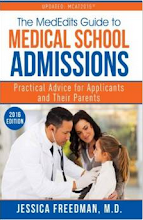
JESSICA FREEDMAN, M.D., is president of MedEdits Medical Admissions (www.MedEdits.com) and author of the MedEdits Guide to Medical Admissions and The Medical School Interview. Follow Dr. Freedman and MedEdits on Facebook and Twitter.This article appeared in the January/February 2012 issue of PreMedLife magazine.







 Posts
Posts

